5 Improv Games to Build Confidence and Quiet Your Inner Critic
The biggest thing standing between most people and more confidence isn’t a skills gap — it’s the inner critic that fires before an idea even gets a chance. Improv training works on confidence indirectly: instead of telling you to “just be more confident,” it puts you in low-stakes situations where the old patterns of self-judgment simply don’t have time to activate.
Here are five improv games and exercises, drawn from the approach behind The Improv Edge, that build real confidence over time.
1. One-Word Story
A group builds a story one word at a time, going around in a circle. There’s no time to plan a clever contribution — you just have to say the next word. This is one of the fastest ways to prove to yourself that you can perform under uncertainty without a script, which is the core skill confidence is actually built from.
2. Failure Bow
When something goes wrong in an improv class, the response isn’t silence or apology — it’s a small bow, arms out, like a performer taking a curtain call for a mistake. Naming failure openly and moving on, instead of freezing or over-apologizing, retrains your relationship to making mistakes in front of others.
3. Yes, And
The foundational rule of improv: accept what your scene partner offers, then add to it. Practiced regularly, it becomes a habit of engaging with new ideas — including your own — instead of shutting them down before they’re fully formed. Most self-doubt is really just saying “no, but” to yourself before you’ve given an idea a chance.
4. Object Work Without Explaining
Mime using an invisible object with total physical commitment, without narrating what it is. It feels exposing the first few times — which is exactly the point. Committing fully to something that might look silly, without hedging or apologizing for it, is a rehearsal for the same commitment public speaking and creative risk-taking require.
5. Group Mind Walk
A group walks around a room and, without talking, tries to change direction together at the same moment — no signal, no leader. It sounds impossible until it starts working, and when it does, it’s a visceral lesson in trusting instinct over overthinking.
Why This Actually Works
None of these exercises require being funny. What they build is tolerance for uncertainty and a faster recovery from mistakes — which, it turns out, is most of what confidence actually is.
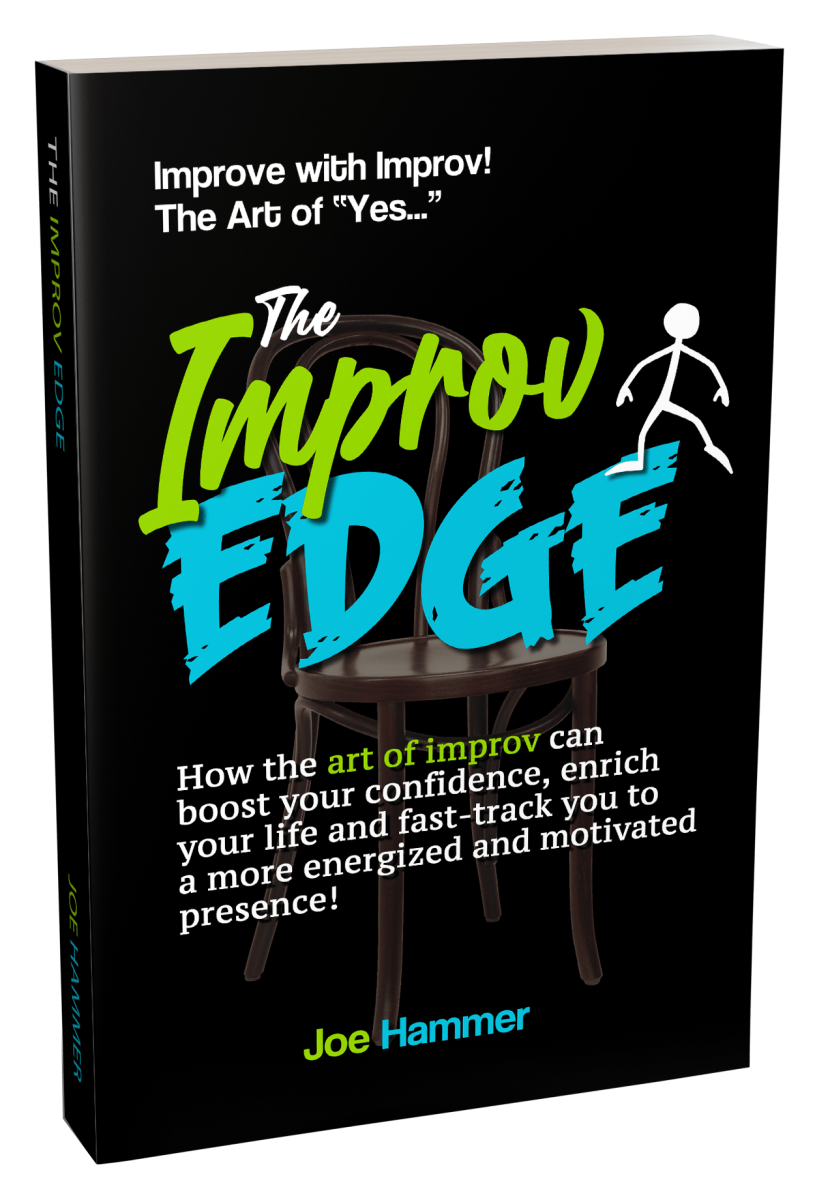
These exercises and many more are covered in depth in The Improv Edge, Joe Hammer’s book on using improv skills for creativity, confidence and spontaneity.
